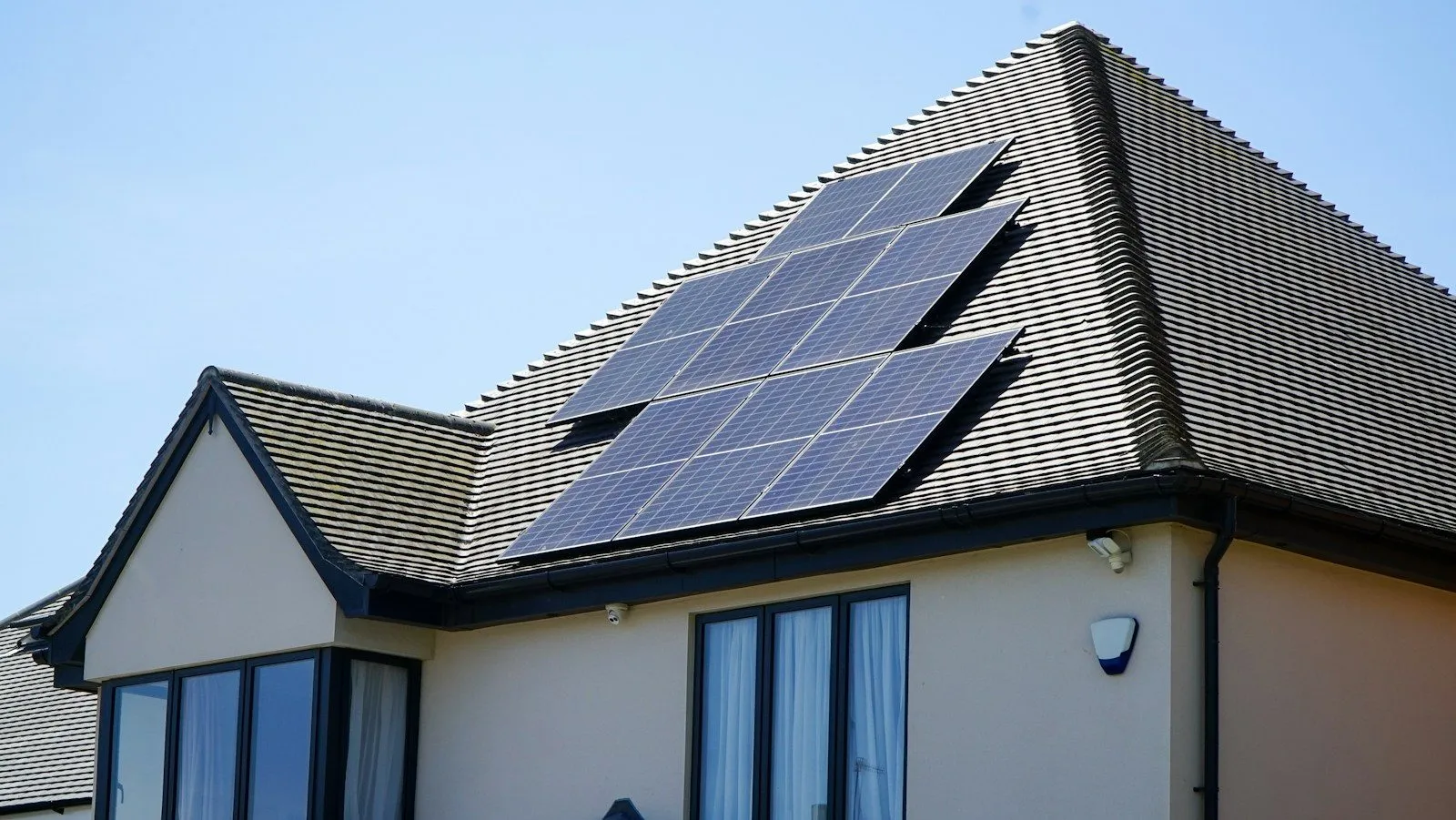
Plug-in vs rooftop at a glance
| Plug-in solar | Rooftop solar | |
|---|---|---|
| Output limit | 800 W AC from the inverter; up to 2,000 W of panels (SI 2026/848; IPS §4.1) | Not subject to the plug-in cap; network rules depend on size (G98 for small systems, G99 above 16 A per phase) |
| Connection | Kit’s moulded plug into a fixed BS 1363 socket (IPS §6.2.3) | Wired into the consumer unit as a BS 7671 Section 712 PV installation |
| Who fits it | You, following the manufacturer’s instructions | An electrician or solar installer |
| Product rules | DESNZ Interim Product Specification; kit must be Compliant on the ENA register | British Standards; MCS certification for SEG |
| Network notification | You notify the DNO, before or within 28 days of plugging in | Installer handles G98/G99 notification |
| How many | One plug-in device per household (Ofgem, G98) | Depends on your connection |
| Export payments | Usually none: SEG needs an MCS installation (gov.uk) | SEG available with MCS certification and a half-hourly export meter |
| Batteries | Not allowed with plug-in kits (SI definition; IPS §1) | Not restricted by the plug-in rules |
| Moving house | Mounting must be reversible (IPS §5.5.1), so it can come with you | Stays with the building |
| Renters and flats | Needs landlord or freeholder permission (IPS §8.3.1) | Permanent building works, so it’s the owner’s decision |
How much electricity does each make?
Per kWp of panels, the sun is the same. PVGIS gives about 1,019 kWh per kWp a year in London and 886 kWh in Manchester, for panels facing south at 35°. What differs is how many kWp you can have.
- per kWp a year, London, south 35°
- 1,019 kWh
- a year from our 0.88 kWp plug-in kit, London
- 897 kWh
- same kit mounted vertically
- 654 kWh
- Plug-in: larger panel arrays are allowed, but the 800 W inverter cap clips the peak. Going to 2.0 kWp adds around 80% more output, not 127% (see how much electricity).
- Rooftop: there’s no 800 W cap. Output scales with the number of panels your roof takes, and the system can be sized to your usage.
Both save most when you use the power as it’s generated. Unpaid export matters more for plug-in, because there’s usually no SEG. See export.
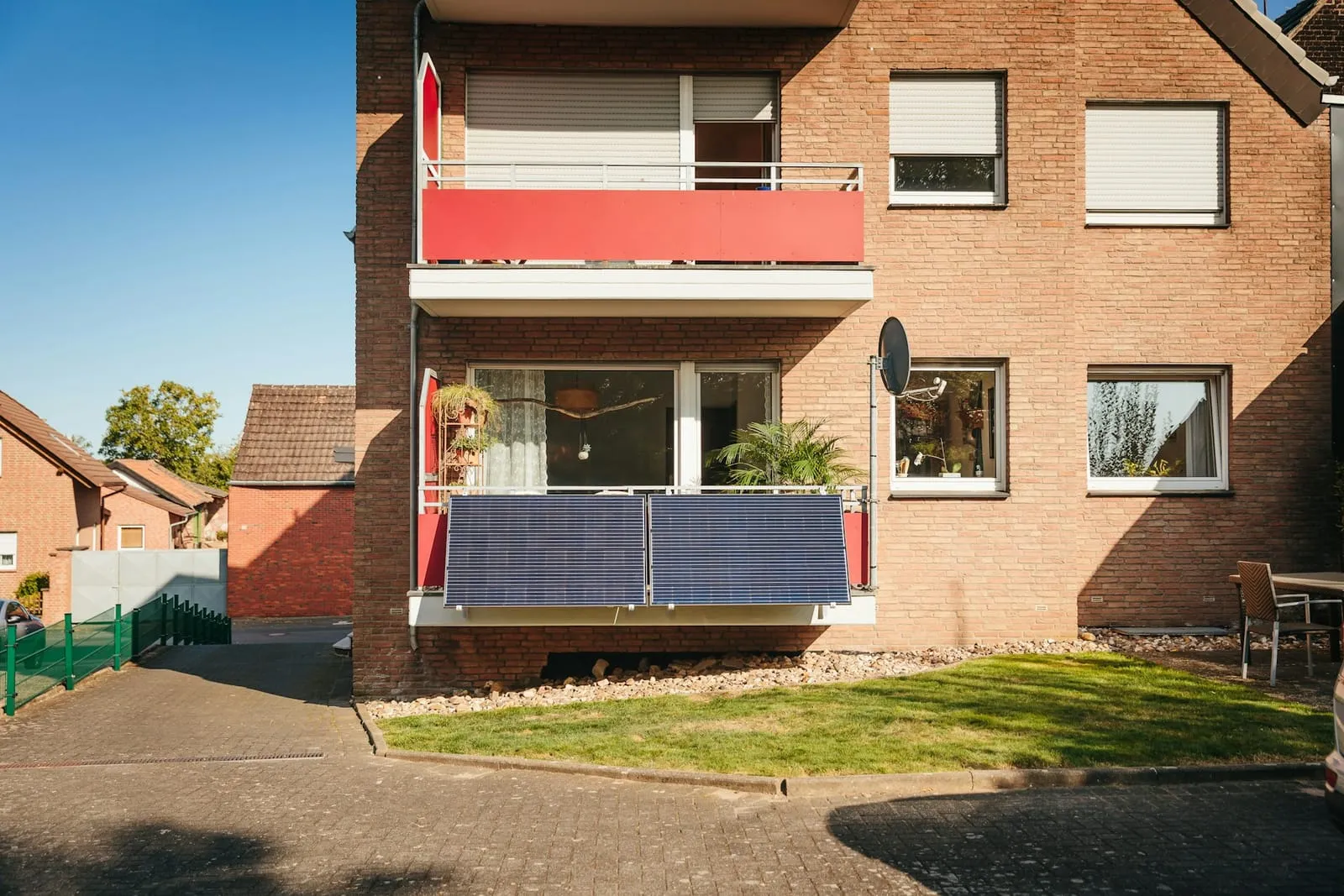
Two panels on the ground-floor balcony of a brick house: the kind of spot plug-in solar is made for.
Which costs less per kWh?
We don’t quote prices here, because they vary and change. The comparison that matters is cost per kWh over the system’s life: the price divided by lifetime output.
Our cost guide shows the method for plug-in kits. Current prices for Compliant kits are on in stock.
Who handles the rules and paperwork?
Plug-in: you do. You’re responsible for:
- picking a Compliant kit;
- getting any permissions (landlord, freeholder);
- checking your wiring;
- registering with your network operator.
In England, plug-in solar is named in permitted development (SI 2026/896), with limits on how far panels stick out and where they go (see planning permission).
Rooftop: mostly the installer. They normally handle network notification and certification. Planning rules for rooftop systems are outside the scope of this guide.
Can you have plug-in and rooftop solar?
Yes, within limits. Ofgem’s decision on the G98 change says a plug-in device may be connected alongside permanently wired microgeneration as long as the total stays within 16 A per phase. Above that, the G99 process applies.
Already have rooftop solar?
Check the combined total against 16 A per phase before adding a plug-in kit. You’re still limited to one plug-in device per household.
Which should you choose?
Plug-in suits you if:
- you rent, or live in a flat or leasehold home (renters, flats, leasehold);
- you don’t have a suitable roof, but do have a sunny balcony, wall or garden;
- you want to try solar with a small outlay and take it with you when you move.
Rooftop suits you if:
- you own your home and have a reasonably unshaded roof;
- you want to cover a large share of your usage, or add a battery;
- you want export payments through the Smart Export Guarantee.
What to do next
- Try a plug-in kit’s numbers for your address in the calculator.
- Narrow down kits with the kit finder, then check prices on in stock.
Sources
- SI 2026/848
- DESNZ Plug-in Solar Device Interim Product Specification v2.0 (July 2026)
- Ofgem decision approving DCRP/MP/26/02 (G98 Issue 2 Amendment 1)
- gov.uk: Smart Export Guarantee
- DESNZ plug-in solar final-stage impact assessment
- SI 2026/896: GPDO (England) Amendment Order 2026
- EU JRC PVGIS 5.3 (non-interactive service)