Your situation
Plug-in solar for balconies
Can you put solar panels on your balcony? Output by direction and angle, the ban on timber balconies, planning limits and what to check before buying.
PVGIS solar data
The numbers
Estimated yearly output of a typical 890 Wp kit (800W cap), from PVGIS solar data for each place. Get yours.
| Setup | London | Manchester | Edinburgh |
|---|---|---|---|
| South-facing, vertical (balcony railing) | 661 kWh | 575 kWh | 607 kWh |
| South-facing, tilted 60° (angled balcony mount) | 869 kWh131% of the first row | 753 kWh131% of the first row | 778 kWh128% of the first row |
| East-facing, vertical | 464 kWh70% of the first row | 408 kWh71% of the first row | 405 kWh67% of the first row |
| West-facing, vertical | 444 kWh67% of the first row | 395 kWh69% of the first row | 399 kWh66% of the first row |
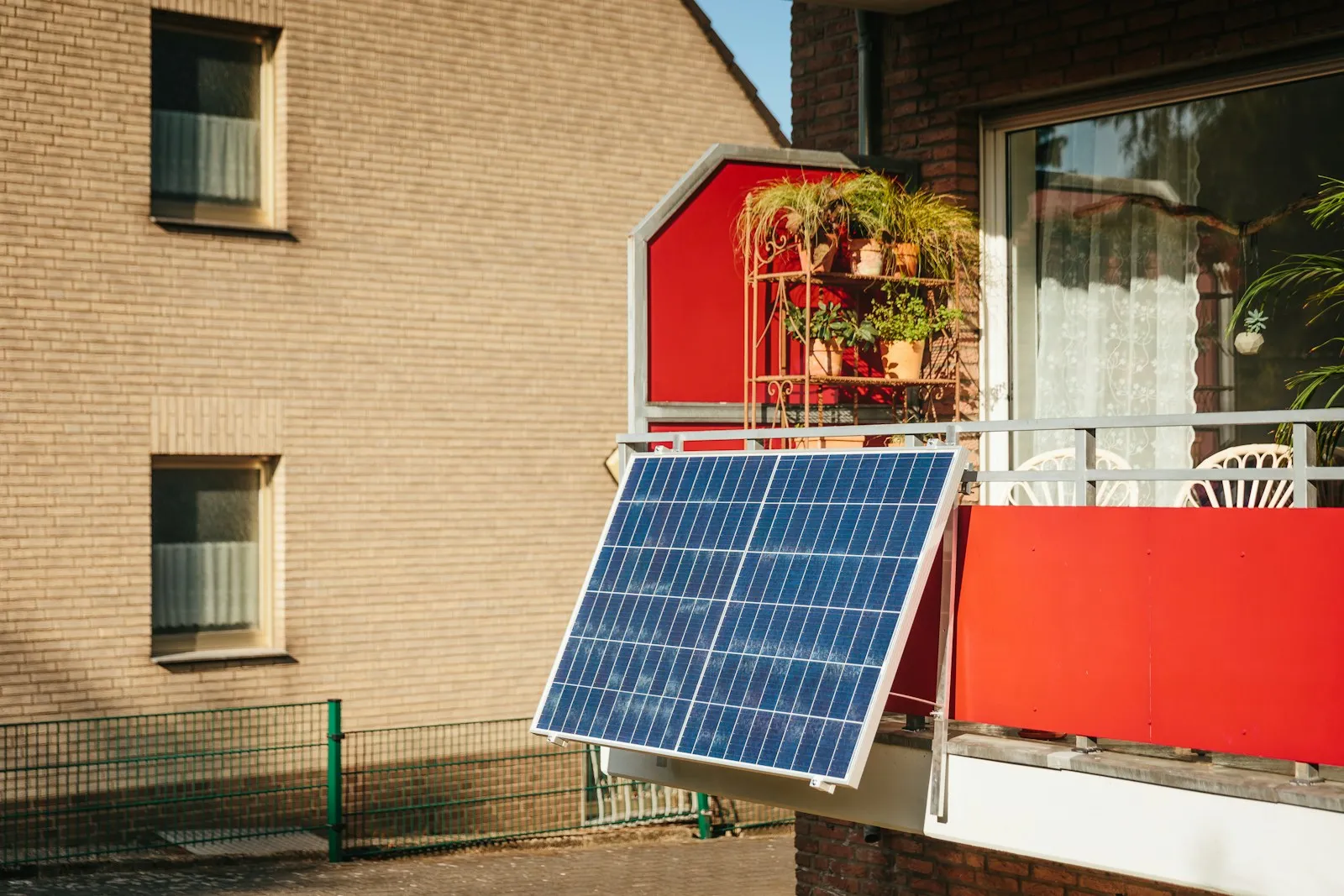
A balcony railing is the classic place for plug-in solar, which is why it’s often called “balcony solar”. Panels hang vertically, or at an angle on a tilting bracket, and the plug goes to a socket just inside. The figures above show how direction and angle change output at your location.
Rules and permissions
No timber balconies. The DESNZ product specification says installations “shall not be permitted on” timber balconies, timber cladding systems, ACM, MCM or HPL cladding systems, or buildings subject to external wall remediation works (IPS §5.8). This applies to the product wherever you are in Great Britain, not only under planning rules. The wording doesn’t say how mixed balconies (for example, a metal frame with a timber deck or handrail) are treated, so if yours is one, ask the kit’s manufacturer before buying.
Permission from the owner. If you rent or own leasehold, the balcony structure probably isn’t yours. You need permission from the landlord, freeholder or managing agent before installing (IPS §8.3.1; DESNZ). See renters and leasehold.
Planning in England. Balcony kits are permitted development on houses and blocks of flats if they stick out no more than 0.2 m from a balcony enclosure on a road-facing side, or 0.4 m elsewhere. They’re not permitted development on a listed building, on a wooden balcony or enclosure, or, in a conservation area or World Heritage Site, on a balcony that fronts a road (SI 2026/896). Listed buildings may need listed building consent (s.7). We found no plug-in-specific planning change in Scotland or Wales; check with your council.
Fixing. Mounting must be reversible and non-permanent, and cable ties, rope, tape, bungees or straps alone aren’t allowed (IPS §5.5.1, §8.3.2).
What to look for
- Railing fit. Measure your railing’s top rail and uprights. Check the kit’s brackets are made for that shape (round, square or flat bar) and thickness, and for glass or solid balustrades if that’s what you have.
- Protrusion. An angled bracket increases output in some positions, but in England it also increases how far the panel sticks out. Check it stays within the 0.2 m or 0.4 m limit.
- Shade. The balcony above, side walls and nearby buildings can shade the railing. Our figures assume open sky.
- Panel size and weight. Wind load on a panel hung on a railing is real. Choose a kit whose mounting is designed for your balcony type and follow its fitting instructions.
- The cable run. The plug must go straight into a fixed indoor or IP55 outdoor socket, with no extension lead (IPS §4.2.3, §6.2.3). Plan a route that won’t pinch the cable in a door or window.
- A listed kit. Check the exact kit is Compliant on the ENA register. See the compliance checklist.