Free tool
Is a battery worth it with plug-in solar?
See what a battery adds to an 800 W kit in your home: how much more of your solar you use, what that saves, and how long the battery takes to pay for itself. Add a cheap overnight rate to see what charging from the grid adds.
- a year used at home with a 2 kWh battery, Birmingham
- +348 kWh
- more saved a year on the price cap
- £89
- quickest payback of the batteries in stock
- 4.7 years
A 1.6 kWh battery pays for itself in
4.7
years, on £399
£87
more a year
+341
kWh of solar used at home
237
full cycles a year
| Measure | Without | With |
|---|---|---|
| Solar used at home | 467 kWh | 808 kWh |
| Sent to the grid | 386 kWh | 7 kWh |
| Saving a year | £119 | £207 |
Over 10 years the battery adds about £798.
How full it gets from solar, month by month
Fills on an average day in 4 months of the year.
| Month | Filled from solar |
|---|---|
| Jan | 19% of 1.6 kWh |
| Feb | 38% of 1.6 kWh |
| Mar | 67% of 1.6 kWh |
| Apr | 100% of 1.6 kWh |
| May | 100% of 1.6 kWh |
| Jun | 100% of 1.6 kWh |
| Jul | 100% of 1.6 kWh |
| Aug | 86% of 1.6 kWh |
| Sep | 76% of 1.6 kWh |
| Oct | 42% of 1.6 kWh |
| Nov | 28% of 1.6 kWh |
| Dec | 20% of 1.6 kWh |
Solar from PVGIS for West Midlands; a 90% round trip and 2% capacity fade a year are our assumptions. Batteries need an electrician: what the rules say.
Before you buy
A battery isn’t a plug-in product
The GB plug-in solar rules cover panels and an inverter of up to 800 W, not storage. Every battery below needs an electrician to install it and tell your network operator, so add their fee to the price.
The law
SI 2026/848 defines a plug-in microgenerator as one that isn’t designed to import from your home’s wiring to store energy for later. A battery that charges from the socket doesn’t qualify.
The product specification
The DESNZ Interim Product Specification (§1) leaves out “plug-in battery systems” and “plug-in solar PV devices integrated with battery systems”.
The regulator
Ofgem says plug-in electricity storage devices “will therefore remain prohibited from being sold, supplied, or used in the UK” as plug-in devices. What that means for you.
Worked example · today’s prices
What each battery we track would add
Added to an 890 Wp kit facing south at 30° in Birmingham, with someone home some of the day and 3 kWh used after dark. Without a battery the kit makes 853 kWh a year and 467 kWh is used at home, saving £119 at the West Midlands price cap of 25.60p.
| Battery | Usable | Price today | Extra solar used | Extra a year | Cycles a year | Payback | Buy |
|---|---|---|---|---|---|---|---|
 Indevolt BK1600 Plug-in Home BatteryIndevoltIn stockElectrician install Indevolt BK1600 Plug-in Home BatteryIndevoltIn stockElectrician install | 1.64 kWh | £399£244/kWh | 344 kWh | £88 | 234 | 4.7 years | Buy ↗Indevolt |
 Zendure SolarFlow 2400 AC+ZendureIn stockElectrician install Zendure SolarFlow 2400 AC+ZendureIn stockElectrician install | 2.40 kWh | £899£375/kWh | 348 kWh | £89 | 161 | 11 years | Buy ↗Zendure UK |
 Zendure SolarFlow 2400 ProZendureIn stockElectrician install Zendure SolarFlow 2400 ProZendureIn stockElectrician install | 2.40 kWh | £1,099£458/kWh | 348 kWh | £89 | 161 | 14 years | Buy ↗Zendure UK |
 Thunder Vault 1.92 kWh Plug-In Home BatteryThunder EnergyIn stockElectrician install Thunder Vault 1.92 kWh Plug-In Home BatteryThunder EnergyIn stockElectrician install | 1.92 kWh | £1,049.99£547/kWh | 348 kWh | £89 | 201 | 13 years | Buy ↗Thunder Energy |
Payback is the battery price alone, before an electrician’s fee, with 2% capacity fade a year. Prices are the best in-stock offer, or the last price we saw if none is in stock. All are marked Electrician install because no battery is covered by the plug-in rules. We don’t have a usable capacity from the maker yet for EcoFlow STREAM Ultra X, EcoFlow STREAM Ultra Pro, EcoFlow STREAM AC Pro, EcoFlow STREAM AC, EcoFlow STREAM Series Solar Battery, Zendure SolarFlow 3680 Mix AC+, Zendure SolarFlow 3680 Mix Pro, Indevolt PowerFlex 2000, Indevolt SolidFlex 2000, Indevolt SolidFlex 3000 Hybrid Pro, Jackery SolarVault 3 Pro Max, Jackery SolarVault 3 Pro Max AC, so they’re left out.
Kits sold with a battery
These come as one package, so the payback is for the whole kit, panels included, in the same home in Birmingham.
| Kit | Panels | Battery | Price today | Saving a year | Payback | Buy |
|---|---|---|---|---|---|---|
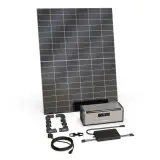 Thunder Bolt Plus 460W Kit with BatteryThunder EnergyIn stockElectrician install Thunder Bolt Plus 460W Kit with BatteryThunder EnergyIn stockElectrician install | 460 Wp | 1.92 kWh | £1,549.99 | £111 | 14 years | Buy ↗Thunder Energy |
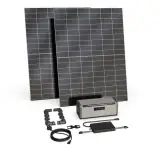 Thunder Bolt Plus 920W Kit with BatteryThunder EnergyIn stockElectrician install Thunder Bolt Plus 920W Kit with BatteryThunder EnergyIn stockElectrician install | 920 Wp | 1.92 kWh | £1,749.99 | £215 | 8.3 years | Buy ↗Thunder Energy |
Bigger isn’t better
Each extra kWh earns less
The same 890 Wp kit and home in Birmingham. A plug-in kit has only so much spare solar, and only in summer. Past a couple of kWh, the extra capacity sits empty most of the year. Want the right size for your home? Try the battery size tool.
| Usable capacity | Extra solar used | Extra a year | Months it fills | Cycles a year | Saving per kWh of battery |
|---|---|---|---|---|---|
| 0.5 kWh | 153 kWh | £39 | 9 of 12 | 339 | £78 a year |
| 1 kWh | 257 kWh | £66 | 7 of 12 | 285 | £66 a year |
| 1.5 kWh | 330 kWh | £84 | 4 of 12 | 244 | £56 a year |
| 2 kWh | 348 kWh | £89 | 0 of 12 | 193 | £44 a year |
| 3 kWh | 348 kWh | £89 | 0 of 12 | 129 | £30 a year |
| 5 kWh | 348 kWh | £89 | 0 of 12 | 77 | £18 a year |
Solar from PVGIS 5.3; West Midlands unit rate 25.60p (Ofgem price cap, October to December 2026). 3 kWh after dark is our assumption, as are the 90% round trip and the average day in each month. Ten years of a 2 kWh battery’s extra saving comes to about £814.
How we work it out
Where a battery’s saving comes from
- Spare solar. We split each month’s output from PVGIS into what your home uses as it’s made and what’s left over, using the same model as the calculator, with the 800 W output cap.
- Into the battery. On an average day of each month the battery takes the spare, up to its usable capacity, and never more than you use after dark.
- Out in the evening. 90% of what goes in comes back out. Each kWh saves your unit rate, less any export payment the spare would have earned.
- Cheap overnight top-up (optional). On a time-of-use tariff the battery fills overnight with whatever the next day’s sun won’t provide, when the peak rate is worth more than the cheap rate after losses.
When it pays
Who a battery suits
- Out all day, busy evenings. More of the kit’s output is spare, and you use it after dark.
- A cheap overnight rate. The battery earns in winter too, when the sun can’t fill it.
It suits you less if you’re home all day: the kit’s output is mostly used as it’s made, so there’s little left to store. For a kit without a battery, see is plug-in solar worth it.
Batteries and plug-in solar: questions
Is a battery worth it with plug-in solar?
Usually not on payback alone. With an 890 Wp kit facing south in Birmingham, a 2 kWh battery stores about 348 kWh a year that would otherwise go to the grid, worth about £89 a year at the 25.60p price cap rate. The quickest payback among the batteries we track in stock is 4.7 years (Indevolt BK1600 Plug-in Home Battery at £399), before any electrician's fee. It pays back faster if you're out all day and use a lot in the evening, or if you also charge it on a cheap overnight rate.
Can I plug a battery into a socket with my plug-in solar kit?
No. The GB plug-in rules don't cover batteries, whether built into the kit or plugged in separately. The DESNZ product specification leaves out plug-in battery systems and kits integrated with them, and Ofgem says plug-in storage devices remain prohibited. A battery needs an electrician to install it as a fixed installation and notify your network operator.
How much extra solar does a battery let me use?
In our worked example (an 890 Wp kit facing south in Birmingham, someone home some of the day), the kit makes about 853 kWh a year and 467 kWh is used as it's made. A 2 kWh battery adds about 348 kWh, taking the share used at home from 55% to 95%.
How many cycles a year will the battery do?
On solar alone, a 2 kWh battery in our example does about 193 full cycles a year: nearly one a day in summer, very little in winter. Charging it on a cheap overnight rate as well can take it close to 365.
Does a time-of-use tariff make a battery pay back faster?
Often, yes. On a tariff with a cheap overnight rate, the battery can top up overnight in the months the sun won't fill it, and you use that energy at the peak rate instead. Each kWh saves the gap between the two rates, less 10% lost in charging. Turn on "Cheap overnight rate" in the tool and enter your tariff's rates.
What does the payback leave out?
The electrician's fee (add your quote in the tool), any standby power the battery draws, and replacement. We assume an average day in each month, one charge and one discharge a day, a 90% round trip and 2% of capacity lost a year. On dull days the battery stores less than our average and on bright days it fills sooner.
Sources
Free tools
Plan the rest of your setup
- Price trackerPrice history, drops and lows for every product
- Price per wattKits, inverters and batteries ranked by value
- Bundle vs buildKit price vs its parts bought separately
- Cost per kWhLifetime cost of solar vs the grid rate
- Export earningsWhat your spare solar is worth
- Tariff matcherWhich tariff gives the lowest bill with solar