Free tool
What’s the best angle for your panels?
Upright on a railing, angled on a garden stand or flat on a roof? See what each angle makes over a year where you live, and why upright panels win in winter.
- best angle facing south in Birmingham
- 40°
- of a 30° stand’s output from upright panels
- 74%
- more from upright panels in December
- +30%
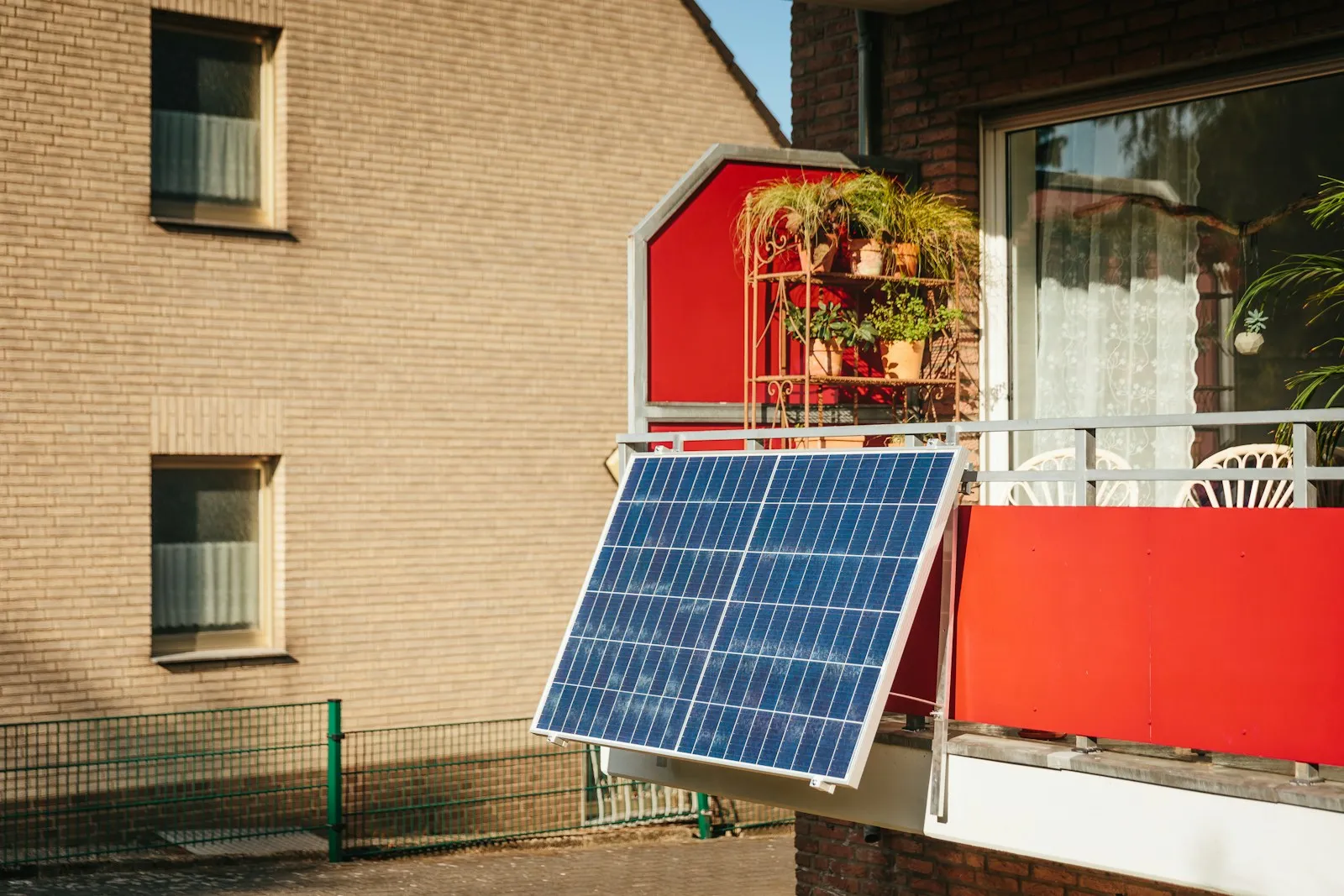
South-facing at 90°
566
kWh a year from 800 Wp of panels, 73% of the best angle
The best angle facing this way is about 40°, at around 775 kWh a year.
Output by angle
| 0° | 643 |
| 5° | 669 |
| 10° | 696 |
| 15° | 722 |
| 20° | 737 |
| 25° | 752 |
| 30° | 766 |
| 35° | 769 |
| 40° | 771 |
| 45° | 773 |
| 50° | 762 |
| 55° | 752 |
| 60° | 741 |
| 65° | 712 |
| 70° | 683 |
| 75° | 654 |
| 80° | 625 |
| 85° | 595 |
| 90° | 566 |
Month by month: 90° against 30°
| Month | 90° | 30° |
|---|---|---|
| Jan | 34 | 28 |
| Feb | 41 | 39 |
| Mar | 56 | 66 |
| Apr | 59 | 86 |
| May | 54 | 95 |
| Jun | 49 | 96 |
| Jul | 51 | 96 |
| Aug | 53 | 85 |
| Sep | 55 | 71 |
| Oct | 47 | 49 |
| Nov | 37 | 32 |
| Dec | 32 | 24 |
90° makes more than 30° in Jan, Feb, Nov, Dec. October to March is 43% of the year at 90°, against 31% at 30°.
PVGIS 5.3 monthly averages near Birmingham, with no shading. PVGIS gives us 0, 15, 30, 45, 60 and 90°; this angle is one of them.
Angle and direction
kWh a year by angle and direction in Birmingham
From 800 Wp of panels with no shading. The percentage is against the best spot in the table.
| Angle | South | South-east | South-west | East | West | North-east | North-west | North |
|---|---|---|---|---|---|---|---|---|
| 0°Flat | 64383% | 64383% | 64383% | 64383% | 64383% | 64383% | 64383% | 64383% |
| 15°Low frame | 72293% | 70091% | 69590% | 64083% | 63282% | 57374% | 56773% | 54470% |
| 30°Garden stand | 76699% | 72994% | 72093% | 62781% | 61379% | 50565% | 49764% | 45058% |
| 45° | 773100% | 72794% | 71492% | 59877% | 58275% | 44257% | 43356% | 35846% |
| 60° | 74196% | 69290% | 67788% | 54871% | 53369% | 37649% | 36948% | 27736% |
| 70°Tilted balcony bracket | 68388% | 63782% | 62381% | 49864% | 48362% | 33143% | 32542% | 23831% |
| 90°Upright | 56673% | 52868% | 51466% | 39651% | 38450% | 24131% | 23631% | 16121% |
From PVGIS 5.3 monthly figures for the nearest data point to Birmingham. 70° is interpolated between the angles either side.
Summer and winter
Upright panels win in winter
In summer the sun is high, so a panel tilted back towards the sky catches it square on. An upright panel sees it at a glancing angle and makes far less.
In winter the sun stays low, and the upright panel faces it almost head on. Facing south in Birmingham, upright panels make more than a 30° stand in Jan, Feb, Nov, Dec.
Output is spread more evenly through the year. October to March is 43% of the year for upright panels, against 31% on a stand.
Upright panels also clip less on an oversized kit. See the clipping calculator.
| Month | Upright (90°) | Garden stand (30°) |
|---|---|---|
| Jan | 34 kWh | 28 kWh |
| Feb | 41 kWh | 39 kWh |
| Mar | 56 kWh | 66 kWh |
| Apr | 59 kWh | 86 kWh |
| May | 54 kWh | 95 kWh |
| Jun | 49 kWh | 96 kWh |
| Jul | 51 kWh | 96 kWh |
| Aug | 53 kWh | 85 kWh |
| Sep | 55 kWh | 71 kWh |
| Oct | 47 kWh | 49 kWh |
| Nov | 37 kWh | 32 kWh |
| Dec | 32 kWh | 24 kWh |
| Year | 566 kWh | 766 kWh |
800 Wp facing south in Birmingham. Highlighted months are where upright panels make more.
Across the UK
Upright against angled, south to north
800 Wp of panels facing south. The further north, the lower the winter sun, and the better upright panels do against a stand.
| Town | Best angle | Garden stand (30°) | Upright (90°) | Upright vs stand | December, upright vs stand |
|---|---|---|---|---|---|
| Plymouth | 40° | 890 kWh | 635 kWh | 71% | +23% |
| Brighton and Hove | 40° | 917 kWh | 661 kWh | 72% | +28% |
| Cardiff | 40° | 827 kWh | 596 kWh | 72% | +26% |
| Birmingham | 40° | 766 kWh | 566 kWh | 74% | +30% |
| Norwich | 40° | 817 kWh | 608 kWh | 74% | +32% |
| Manchester | 40° | 704 kWh | 517 kWh | 73% | +32% |
| Newcastle upon Tyne | 40° | 750 kWh | 574 kWh | 76% | +39% |
| Glasgow | 40° | 681 kWh | 510 kWh | 75% | +37% |
| Aberdeen | 45° | 701 kWh | 541 kWh | 77% | +47% |
| Inverness | 40° | 643 kWh | 485 kWh | 75% | +42% |
From PVGIS 5.3 monthly figures for the nearest data point to each town. Best angle is to the nearest 5°, from a curve fitted through the PVGIS angles either side of the best one.
Choosing a mounting
Angle isn’t the only thing to weigh up
Balcony railing or wall
Upright, out of the way, and best in winter. In England, panels on a wall or balcony may not stick out more than 0.2 m if the wall faces a road, or 0.4 m otherwise (SI 2026/896). Not on timber balconies or cladding (IPS §5.8).
Garden stand
The most over a year, and easy to turn towards the sun. Free-standing panels in England have height limits near boundaries (SI 2026/896). Watch for shade from fences and hedges: try the shade planner.
Flat roof or shed
Often unshaded. A low frame does nearly as well as a stand. Any mounting must be secure, reversible and non-permanent: straps or ties on their own don’t count (IPS §5.5.1, §8.3.2).
Will the panels fit the space? Try will it fit my balcony. More on each option in our mounting guide.
Panel angle: questions
What is the best angle for solar panels in the UK?
Facing south, about 40° gives the most over a year: around 775 kWh from 800 Wp of panels in Birmingham, from PVGIS. A 30° garden stand makes 766 kWh, 99% of that, so a stand anywhere near that angle does well.
Do vertical balcony panels make much less?
Over a year, yes. Upright and facing south in Birmingham, 800 Wp of panels make 566 kWh, 74% of a 30° garden stand. But they make more than the stand in Jan, Feb, Nov, Dec, when the sun is low.
Is it worth tilting balcony panels out from the railing?
Often, yes. Tilting south-facing panels out to 70° makes about 683 kWh a year here, against 566 kWh upright. (PVGIS gives us 60° and 90°; 70° is estimated between them.) Check the kit’s brackets allow it and that the panels stay within the protrusion limits for your wall.
Should flat-roof panels lie flat?
They can, but a low frame helps. Flat panels make 643 kWh a year here, against 766 kWh at 30° facing south.
Which matters more, direction or angle?
Both, and they interact. Upright panels lose more when turned away from south: an upright east-facing wall makes 396 kWh a year here, against 566 kWh upright facing south. Flat panels don’t care which way they face.
Where do these figures come from?
PVGIS 5.3, the European Commission’s solar data service, using 2005–2023 weather and its standard 14% system loss. We hold its figures for six angles (0, 15, 30, 45, 60 and 90°) and eight directions at points across the UK, and estimate angles in between. They assume no shading.
Sources
Free tools
Plan the rest of your setup
- CalculatorOutput, savings and payback for your home
- Kit finderThree answers, a shortlist of kits in stock
- Shade plannerDraw your horizon, see what shade costs
- Will it fit?Which panels and kits fit your space
- Clipping calculatorWhat oversized panels lose to the 800 W limit
- What can it run?Which appliances 800 W of solar can power