Your situation
Plug-in solar for east- or west-facing homes
East or west-facing plug-in solar compared with south for your area, why the timing can suit your usage, and the rules that apply.
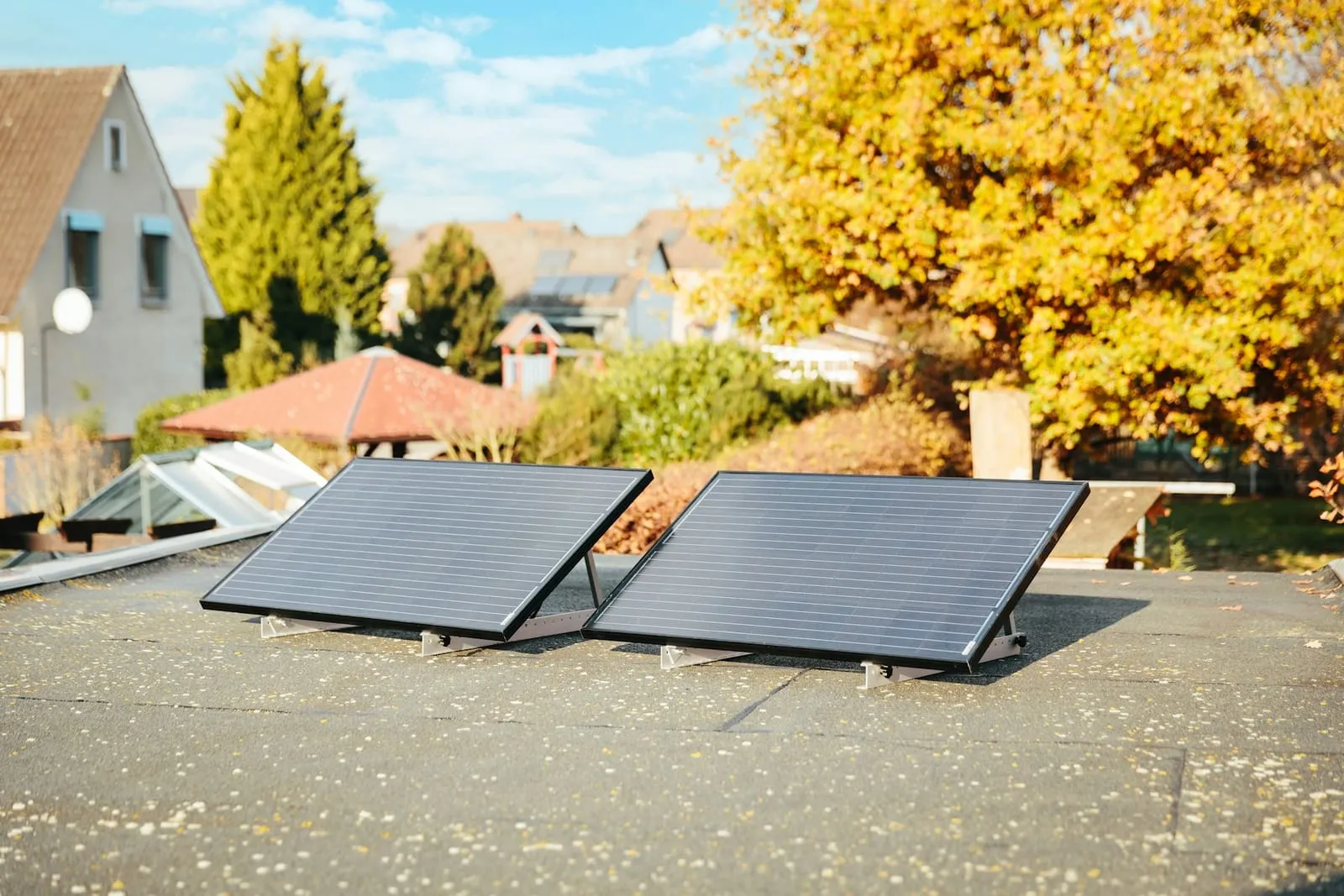
PVGIS solar data
The numbers
Estimated yearly output of a typical 890 Wp kit (800W cap), from PVGIS solar data for each place. Get yours.
| Setup | London | Manchester | Edinburgh |
|---|---|---|---|
| East-facing, tilted 30° | 736 kWh | 646 kWh | 635 kWh |
| West-facing, tilted 30° | 712 kWh97% of the first row | 634 kWh98% of the first row | 631 kWh99% of the first row |
| South-facing, tilted 30° | 899 kWh122% of the first row | 783 kWh121% of the first row | 795 kWh125% of the first row |
| West-facing, vertical (balcony or wall) | 444 kWh60% of the first row | 395 kWh61% of the first row | 399 kWh63% of the first row |
Many balconies and walls face east or west rather than south. The rows above compare east, west and south at the same angle for your area, plus a vertical west-facing panel, so you can see the gap in your own location rather than relying on a rule of thumb.
Total output is only half the story. An east-facing kit produces most in the morning and a west-facing one in the late afternoon and early evening. Because plug-in kits can’t store power and exported electricity is usually unpaid, what matters is how much of the output you use as it’s produced. DESNZ’s impact assessment assumed a household would use a higher share of the output from a vertical east/west kit than from a south-facing one at 30°, although the total output was lower (impact assessment, Table 7). Our calculator works this out hour by hour for your usage.
Rules and permissions
The rules don’t depend on direction:
- Permission. Renters, leaseholders and residents of managed buildings need permission from the landlord, freeholder or managing agent before installing (IPS §8.3.1; DESNZ).
- Surfaces you can’t use. No timber balconies, and no timber, ACM, MCM or HPL cladding (IPS §5.8). No walls that form a boundary between homes (IPS §8.3.2).
- Planning in England. Wall and balcony kits must stick out no more than 0.2 m on a road-facing side or 0.4 m elsewhere. They aren’t permitted development on listed buildings or on wooden walls, balconies or fences. In conservation areas, nothing may go on a wall, balcony or roof enclosure that fronts a road (SI 2026/896). We found no plug-in-specific planning change in Scotland or Wales.
- One kit per household, registered with your DNO. See how to register.
What to look for
- Match the direction to your day. If the house is empty in the mornings, a west-facing spot may be worth more to you than its annual total suggests, and an east-facing one less. The reverse is true if you’re out in the evening.
- Two directions from one kit. Some kits let you point panels in different directions, one east and one west. The product specification allows up to four panels on one kit, with no more than two in series and no Y-connectors (IPS §4.2.2). Only set panels up in a way the manufacturer’s instructions allow.
- Extra panel power. East and west-facing panels rarely all reach full output at once, so a kit with more panel capacity than 800 W may clip less than it would facing south. Check the kit’s yield figures for your direction.
- Shade at low sun. Morning and evening sun comes in low, so nearby buildings and trees matter more. Our figures assume open sky.